In 1922, Walter Lippmann, a renowned journalist and critic, introduced the modern use of the term stereotype to describe fixed beliefs and representations held by society about specific social groups. Borrowing from printing terminology, Lippmann used this term to illustrate how societal norms and cultures create "fixed templates" to define, disseminate, and solidify collective beliefs about groups. Similar to traditional printing methods—where each letter is arranged in a mold to reproduce identical copies—stereotypes function as rigid frameworks that cement perceptions into singular, immutable forms, disguising them with an aura of objectivity and authority.
Among the many forms of stereotyping, gender stereotypes are the most deeply entrenched. They assign predetermined roles, characteristics, and behaviors to men and women, such as “work belongs to men, home belongs to women” or “science is for men, art is for women.” These binary constructs perpetuate outdated societal norms, reinforcing a dichotomy that restricts individual freedoms. Gender stereotypes not only confine women to traditional caregiving roles but also impose hidden constraints on men, pressuring them to embody strength and success at all costs. Together, these stereotypes uphold patriarchal systems that limit personal agency and reinforce societal inequalities.
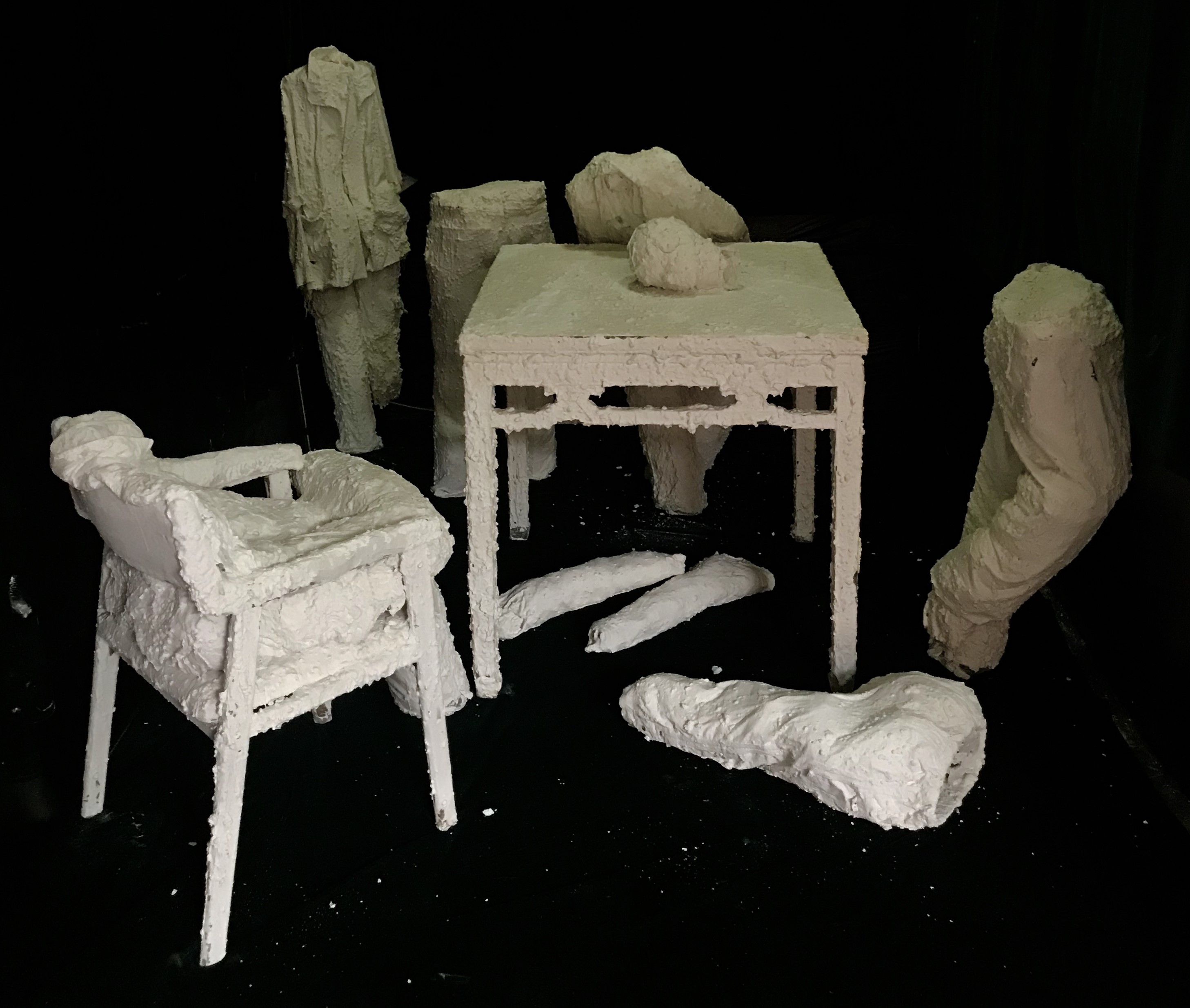
My work, Prescribed Metamorphosis, explores the pervasive impact of gender stereotypes through the interplay of transformation and constraint. The title encapsulates the tension between societal prescriptions and the possibility of personal and collective metamorphosis. Drawing inspiration from the Chinese "Five Elements" (Wuxing) philosophy, I use wood and earth as primary materials. In this framework, wood represents growth and vitality, while earth symbolizes grounding and structure. These elements embody cycles of interaction and opposition, much like the interplay of gender norms and individual agency within society.
The sculptural forms in the work are deliberately ambiguous, resisting binary categorizations of male and female. Wooden frames and plaster casts create a fluid space for interpretation, inviting viewers to question rigid notions of gender. At the center of the installation, an Eight Immortals Table (Baxianzhuo) symbolizes the enduring dominance of patriarchal authority. Surrounding the table are fragmented, fragile, and resisting bodies—figures that reflect the struggles and critiques of gender stereotypes in both familial and societal contexts.
Critique of Gender Stereotypes
The work draws on Judith Butler’s theory of gender performativity, which posits that gender is not innate but rather a set of repeated behaviors shaped by societal expectations. By highlighting the cultural construction of gender, the piece challenges the perception of masculinity and femininity as fixed and immutable traits.
Gender stereotypes perpetuate significant harm by enforcing rigid roles and expectations. For instance, caregiving roles are disproportionately assigned to women, even in circumstances where men might be better suited to the task. A father who becomes a full-time caregiver often faces societal ridicule, branded as “unsuccessful” or “dependent.” Conversely, women who pursue leadership or non-traditional careers frequently encounter skepticism and systemic barriers. These stereotypes deny individuals the freedom to express their authentic selves and follow their desired paths.
When an individual’s gender identity, expression, or orientation deviates from societal norms, they are often labeled as deviant and subjected to discrimination or violence. In professional settings, women are frequently perceived as lacking leadership or decision-making abilities, while men are pressured to conform to traditional ideals of success. Such dual oppression traps individuals in roles that may be misaligned with their true identities, creating cycles of frustration and limitation.
Artistic Reflection and Vision
Prescribed Metamorphosis aims to deconstruct the notion of gender as a natural or fixed binary. The ambiguous forms in the artwork resist clear definitions, symbolizing the potential for individuals to transcend societal labels. The fragmented bodies around the Eight Immortals Table evoke the pain and contradiction of living under patriarchal systems, while the materials of wood and earth suggest growth and transformation within structural constraints.
This work is not merely a critique but also a call to action. It urges viewers to reflect on how stereotypes shape their perceptions and interactions and to recognize the fluidity and uniqueness of individual identities. By doing so, it aligns with contemporary efforts to dismantle traditional gender norms and celebrate diversity in gender expression.
Breaking the Mold: A Global Perspective
Efforts to break down gender stereotypes are gaining momentum worldwide. For example, New Zealand’s Prime Minister Jacinda Ardern exemplified this shift by leading her country while becoming a mother, supported by her husband Clarke Gayford, who took on the role of a stay-at-home father. This reversal of traditional roles was not met with scorn but rather celebrated as a model of partnership and progress. Such examples demonstrate that it is possible to transcend rigid templates and create a society where individuals are valued for their contributions rather than their conformity to outdated norms.
If we fail to acknowledge the similarities between men and women and continue to treat them as fundamentally different, our world will remain constrained by gendered biases. Overcoming these stereotypes requires conscious effort and reflection. Perhaps the first step is to pause before telling a boy how brave he is or a girl how kind she is and instead consider the underlying frameworks shaping these compliments. By questioning these norms, we can create space for a freer, more authentic way of living.